
The Last Line on Nepo Babies: An Interview with the Iconic Fran Hoepfner
Re:Viewed by Spencer Williams
Summer 2026
RE:VIEW
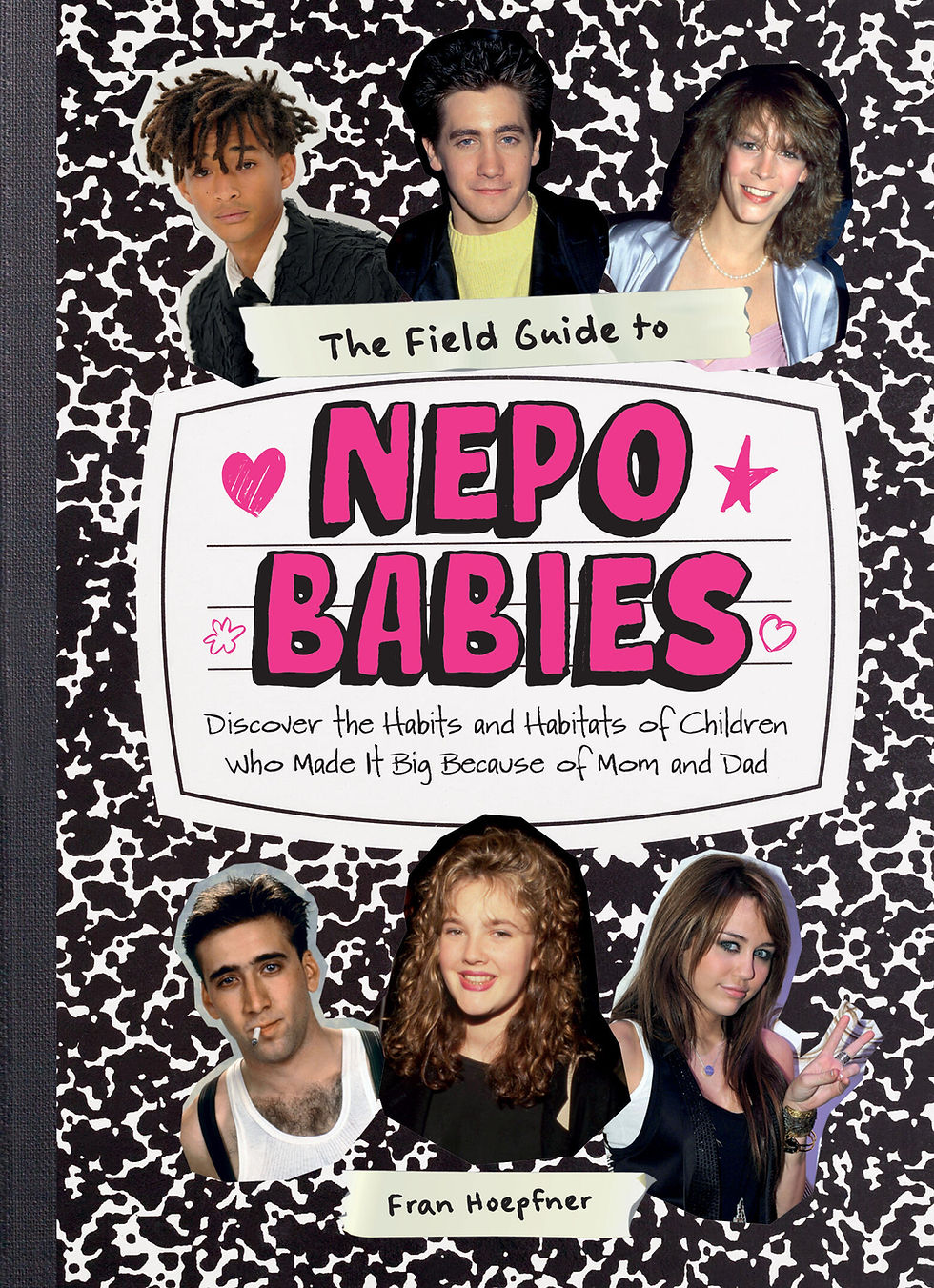
I’ve always said this: Fran Hoepfner is one of our greatest and funniest minds.
We, the public, are lucky to be able to read her in the digital pages of Vulture and in the wonderfully wry and informative new book The Field Guide to Nepo Babies, available for purchase wherever you buy your books (except Urban Outfitters, which I learned no longer sells books). Also be on the lookout (or else) for her debut novella, Fine-Tuning, coming to you in the summer of 2027 via 831 Stories.
I was lucky enough to speak with Hoepfner about all things nepo baby, including favorite and least favorite contemporary nepos, and what it would mean to finally move beyond the discourse. Somehow, we also talk about Jesus, maybe the ultimate nepo baby.
Spencer Williams: This book reads to me as essentially the final word on nepo baby discourse. Like there’s nothing else to say now that this book exists. Was your goal to end or complicate said discourse about nepo babies?
Fran Hoepfner: This question unleashed a horrifying thought in me the first time I read it: what if no discourse is ever really over? That’s too scary to think about, though, so let’s not give it much consideration. Discourse cycles now kind of remind me of when Kylie Jenner said 2016 was “the year of realizing things.” It’s kind of been the year of realizing things every year since. My goal, however, was to end this iteration of discourse about nepo babies, which is rooted almost entirely in identification. So that’s part of the book, of course—it’s a “field guide”—but I wanted to explore the “so what?” of everything. We can’t make Lily-Rose Depp change who her parents are, so what are we gonna do about it? Everyone’s parents are something or another. To talk about nepo babies is to talk about privilege and access and capitalism, but I’m hoping that with this book out, we can maybe move on to different iterations of those conversations about more pressing and local problems.
SW: The nepo baby inspires such a range of hot-blooded emotions, from intense jealousy to rage to utter bafflement. But your book refuses to embody such heightened effects—it reads to me as very “academically” (positive) grounded, though that’s not to say boring. Talk to me about crafting the tone of this book, which I think very easily could have been zinger after zinger without the genuine interrogation of the subject that you perform.
FH: I really wanted the book to feel grounded and well-informed. What helps, I think, is that I am pretty nepo baby neutral. I’m not really offended by, nor enamored with, their existence. I’m certainly a little jealous, especially of the ones in the arts who I imagine grew up with the profound privilege of being so close to so much art (to say nothing of the wealth…). But I’ve been in the weeds with nepo babies for forever. I imagine a lot of people have. I grew up with the kids whose ancestors founded my hometown. I did an unpaid internship alongside a Republican politician's kid. I have beloved friends whose parents have varying degrees of cultural caché. It’s a weird world! I tried to be both generous and a little petulant, but mostly level-headed. The concept of nepotism can be really, really frustrating when you’re in college and those nascent years after graduation if you are lucky enough to learn how unfair the world is when you’re in your 20s. Being a little older, I’ve made peace with the nature of nepo babies, even if I’m not crazy about them all.
SW: How did you determine which nepo babies deserved page space and which ones didn’t? What was your selection criteria? Any surprise nepos make the cutting room floor?
FH: I fear my answer here is a little boring: I tried to gauge who is relevant, who is in stuff, who is on my screen and my phone, and who is being asked to talk about it. Thinking outside of entertainment was really fun, because then I got to delve into the worlds of art and music and tech and politics and flex some of my Rich Kids of Instagram knowledge by throwing someone like Gaia Matisse in there. I always love when the nepo baby is, like, related to someone really old. I know the composer Sergei Prokofiev’s grandson is a DJ in London. One of the twinks in Benediction—Matthew Tennyson—is like the great, great, great grandson of Alfred, Lord Tennyson. Neither of those last two are in the book, but they’re always the most fun to me. Maybe the most surprising cutting room floor nepo baby is Ben Platt, who got into some drummed-up hot water over a “no comment” when asked about his status a few years ago. I kind of felt like he had endured enough ridicule, and I liked when he sang “Diet Pepsi.”
SW: Who is your favorite culturally relevant nepo baby and who is your favorite forgotten nepo baby?
FH: I love so many of them, truly, that it’s hard to pick a favorite one. Maybe Laura Dern? I mean having Bruce Dern and Diane Ladd as your parents—there’s a reason she’s the coolest. My favorite “forgotten” nepo baby is forgotten mostly on account of not being American, and that’s Léa Seydoux. Her grandfather is the founder of Pathé, which is a major French distributor and production company. It’s sort of like, wow, the girl from all the movies with the Pathé logo in front of them is the granddaughter of Mr. Pathé himself… But she’s a genius.
I will also tell you my least favorite culturally relevant nepo baby, if you want…
SW: PLEASE
FH: Jack Schlossberg. I don’t live in the district in which he’s currently running for Congress (though, don’t worry… I still have an annoying and bad congressperson), but I find his campaign to be a strange and embarrassing waste of time and money.
SW: In a world where everyone is “mother,” who’s to say we aren’t all nepo? If you were a nepo baby, what industry would you want to inherit from your parents?
FH: I mean, I actually don’t wish to be the child of a famous actor or director or writer, even. That seems like a stressful upbringing. Given the media is collapsing, I guess I would have loved to inherit like a full-blown trade from my parents—plumbing? Blacksmithing? Baking bread? Someone I went to college with grew up in a restaurant family, which I always thought felt so romantic and storybook.
SW: Why do you think it’s so difficult for celebrities to get the “nepo” soundbite right? Allison Williams is but one of a few who seems to have nailed it, but why do you think so many fail in their response to “nepo allegations”?
FH: I don’t envy them: you can’t choose your parents! And the other thing I feel like I have to constantly remember about celebrities in particular is that most of them do not go to college, let alone liberal arts college, where you’re basically taught how to apologize for yourself as an artform. Unless their parents are actively trying to raise them in a civilian lifestyle with public education and out-of-industry experiences, it’s just a really sheltered form of living where every need is met and every discomfort is comforted. Those who have called it a form of bullying are being sincere, I think, in that this is what bullying is to them, and not, like, a random kid at school calling you fat, as was the case for me. I do think they’re starting to get better at responding to the allegations of nepotism, but not in a way that shows humility. I think they’re starting to own it in a way that’s funny and maybe even brattier.
SW: In your book, you claim Jesus Christ is a nepo baby. The same could be said for any of the Greek gods fathered by Zeus, or like, Jack Jack from The Incredibles. Would you say religion, and/or various mythologies, are actually indebted to nepo babies?
FH: Well, I argue that Christ both is and isn’t: it depends how literal you decide to take “son of God,” and also what the concept of “God” even is in the first place. The Greek gods definitely are, and lord knows Jack Jack is culpable. So much Western religion is founded on families as the central holy unit—who is related to whom and what they all did to each other.
SW: This raises an interesting quandary. I’m always thinking about the “not even to dinner with the Kushners?” moment on Project Runway. Obviously, you can choose what family you marry into and stuff, but are there ways to think about our relations to one another in ways that don’t ever stick? Like, if I, a nepo baby, know my dad or whoever is evil, but I’m not, what is my responsibility to distance myself from the source of nepotism? How does a nepo clear their name or wipe the slate when their name is synonymous with bad news?
FH: I think it’s genuinely a very tricky question. I mean, no one can pick their parents, really, and there are plenty of bad parents or parents who perpetuate evil who aren’t in any way famous. Maybe they’re just weird tech people or stockbrokers or whatever. I don’t think anyone has a responsibility to professionally distance themselves, but the conclusion my book comes to is that there’s got to be a way to use that privilege to try to better systems, if possible, and move toward a general redistribution of wealth. I don’t think that’s something that necessarily has to be done in direct opposition of one’s parents—it could be in a totally separate field. I think nepo babies previously tried to clear their name by just literally having a different last name. To some extent, that still works.
It’s this specific phenomenon that has me so curious about Zoe Kazan’s adaptation of East of Eden, which her grandfather adapted last century. Elia Kazan was met with a ton of ire—rightfully so—by naming names during his HUAC testimony. Zoe has been somewhat vocal about her discomfort with that decision being part of her legacy, but this is the first time she’s really stepped into her family name and is doing a project that feels very much in conversation with the work of a family member. I’m dying to see how it turns out, and how it improves upon (if possible) or converses with Elia’s film.
SW: The structure of the book is hyper-stylized, with photos, paintings, bullet points, and everything you’d want from an extremely detailed PowerPoint at a party or comedy night. How did you settle on the structure of the book and what was your process of sourcing imagery and pull quotes?
FH: The structure of the book was inherent to the pitch, which was trying to combine and express all that I found fun about celebrity gossip and magazines and picture books when I was a young person learning about the world. I always loved those composition notebooks and when books I read took that form, like Amelia’s Notebook. I wanted the book to feel interactive or like something you could have a party to pull out for quizzes or games. I used to love doing Cosmopolitan quizzes over and over again with different people. There’s a timeless quality to that style that I was keen to bring back with a book like this.
I can’t take any credit for sourcing the imagery, but the team at Workman did phenomenal work in making this book look completely and utterly gorgeous. I remember getting my first draft of the book with the images and pull quotes and being totally gobsmacked by it. The book is so colorful and entrancing and makes reading really fun. I spend a lot of my free time reading big, long, dense books with a lot of small fonts. The idea of making something the total opposite of that was a great stretch of my imagination and what the experience of reading could feel like.
SW: Make Reading Fun Again… Would you recommend I, or anyone, teach this book to college freshmen?
FH: Yes! I think the earlier people can get nepo baby hatred out of their system, the better. Plus, learning this kind of information when you’re in college will make you a fun fact machine at dinner parties for years to come. The sooner in life you can identify and weaponize knowledge of privilege, the more normal you’ll turn out—I think.
SW: I noticed I’m not named in the Acknowledgments. Can you speak to my lack of influence on this project?
FH: I’m such an Acknowledgments section snoop, so I realize how disappointing it is to see a lack of proper nouns. I said I left everyone out because of a glut of love and support, but really it’s just in case a nepo baby comes after me, I want to protect you. I’m being generous, obviously.

FRAN HOEPFNER is a senior news writer with Vulture who covers pop culture and the internet. She also publishes the weekly Substack Fran Magazine. Her new book The Field Guide to Nepo Babies was published by Workman Publishing Company in 2026, and her debut novella Fine-Tuning is forthcoming summer 2027 via 831 Stories.
SPENCER WILLIAMS is the author of TRANZ (Four Way Books, 2024) and Dirt Talk (Four Way Books, 2027). Her work has been featured in Poem-a-Day, American Poets Magazine, Muzzle, and Lithub. She is currently a PhD candidate in poetics at SUNY, Buffalo. She is always on the brink of throwing her phone off a very tall building.
To read more from Brink, subscribe or purchase a single issue in our shop.


Comments